
What is the real problem when choosing a DSP or publisher for U18 audiences?
Today, a brand that wants to safely reach children and teen audiences has to choose between different COPPA-compliant inventory providers, different DSPs, and different measurement tools. In practice, a large share of that spend ends up where it shouldn't: it's estimated that up to 70% of ad spend aimed at U18 audiences on YouTube ends up on adult content, simply because the available targeting tools weren't built for this specific audience.
This isn't a "lack of options" problem, it's a segmentation problem. Each DSP on the market tends to solve only one piece of the puzzle: some bring inventory, others delivery technology, some compliance. None, until now, has published an honest comparison of which piece each one solves, and brought every piece together.
What does a complete U18 campaign actually need?
Before comparing platforms, it helps to be clear on what a campaign aimed at children or teens really needs in order to be effective and safe:
- Data: understanding who the audience is without collecting the minor's personal data, segmenting by age range, interests and context, never by individual profile.
- Delivery: curated inventory (YouTube, apps, Roblox) already classified by age range and thematic alignment, not general inventory with a "brand safety" filter bolted on afterward.
- Creative: a proprietary format catalog, calibrated by age bracket and level of interactivity, from simple videos and interactives to minigames and immersive Roblox experiences, not one generic format later adapted for children and teens.
- Measurement: reporting that shows real campaign results for this specific audience, not generic industry benchmarks.
Most solutions available on the market today solve one or two of these four pieces. Kidscorp was designed, from day one, to solve all four within a single platform.
Kidscorp vs. other publishers and DSPs: comparison table
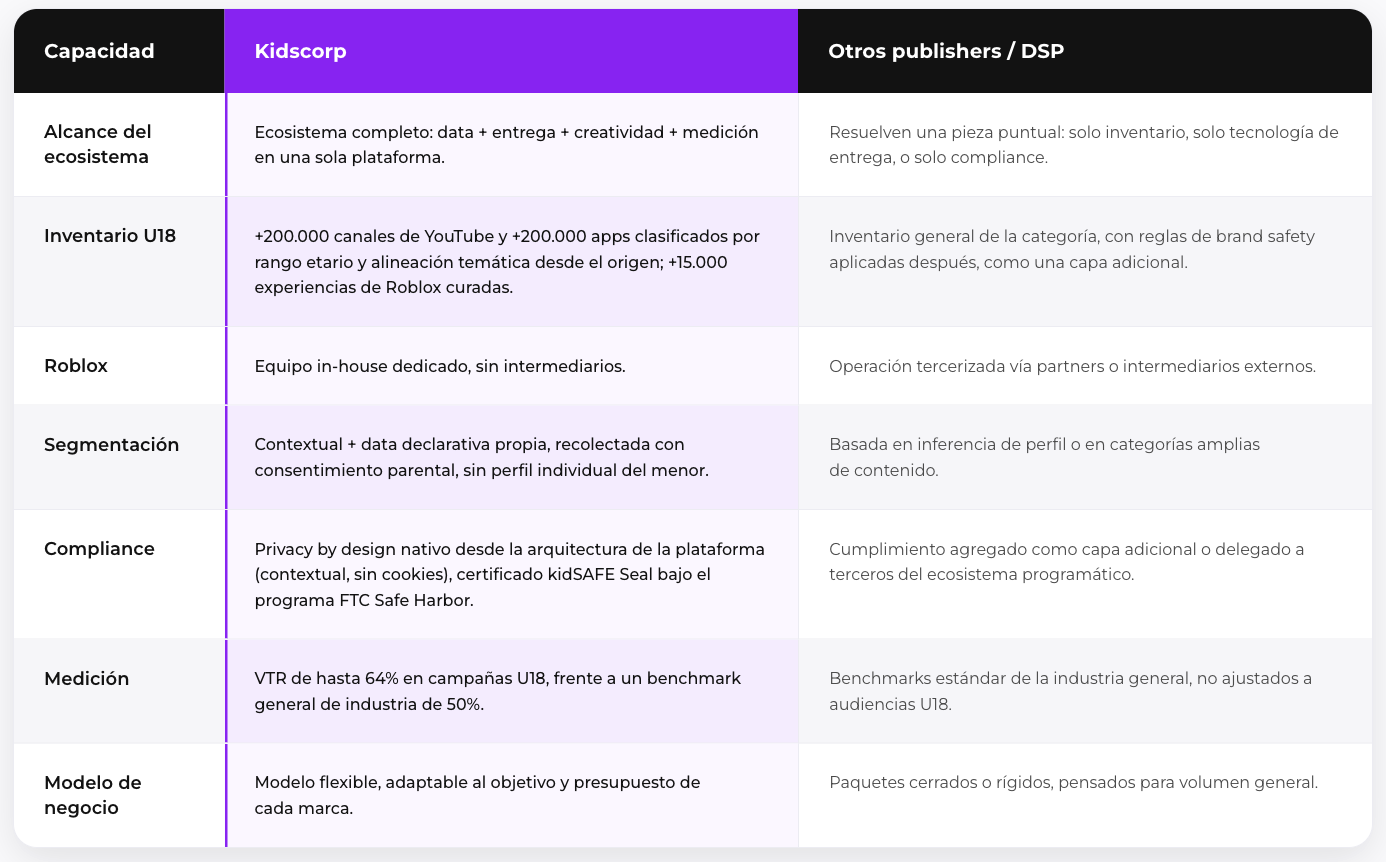
Many providers offer a very wide inventory scale and are already integrated into the same programmatic platforms that trading teams use for the rest of their campaigns. With standardized buying processes, they end up being the simplest option when U18 is only a minor fraction of a brand's total budget.
Kidscorp doesn't compete to be the biggest DSP in the market overall. That's not the goal. Kidscorp is built exclusively to solve the complete U18 audience ecosystem: that's the difference between a provider that adds U18 compliance to its general offering, and a platform built from scratch, with native compliance, exclusively for this audience.
Compliance by architecture
Almost all privacy regulation for minors around the world, including COPPA in the United States, GDPR-K in Europe, and LGPD and ECA Digital in Brazil, revolves around the same principle: advertising to a minor is not prohibited; profiling them or collecting their personal data without verified parental consent is.
That's the structural difference between a general-audience DSP that adds a U18 compliance layer, and a platform built on that principle from the start:
- Contextual, not behavioral: segmentation is done by content, topic and context, never targeted at an identified individual.
- Proprietary declarative data: more than 84,000 families surveyed per year across the region, with parental consent and verification that the respondent is actually a minor.
- Transaction-level compliance: bidding technology actively blocks third-party trackers from extracting personal data during the programmatic auction, this isn't just a policy, it's a technical restriction.
- Active certification: kidSAFE Seal under the FTC Safe Harbor program, which backs COPPA compliance.
This isn't an isolated compliance argument: it's the structural reason a DSP designed for general audiences can't replicate the same thing without redesigning its architecture from scratch.
Frequently asked questions
What sets a U18 DSP apart from a generic DSP?
A generic DSP buys inventory for general audiences and applies brand safety rules afterward. A U18 DSP like Kidscorp was designed from the ground up with age-curated inventory, segmentation without personal data, and native compliance with COPPA, GDPR-K and LGPD.
Can you run targeted advertising to children without violating COPPA, GDPR-K or LGPD?
Yes. These regulations don't prohibit advertising to a minor, they prohibit profiling them or collecting their personal data without verified parental consent. Contextual segmentation (by content, aggregated age and interests, with no individual profile) is the model global regulation allows.
Does Kidscorp replace other publishers or DSPs, or work alongside them?
It depends on each brand's objective. For a campaign focused specifically on U18 audiences, Kidscorp solves the complete ecosystem on a single platform. For a broader media strategy, Kidscorp can run in parallel with other providers as the specialized piece for children and teens.
How do you guarantee the campaign doesn't reach adults?
Real age range, not behavioral proxies. A proprietary whitelist of over 200,000 certified channels. Delivery and view-through rate broken down by age, with 24/7 access to the list.
In summary
Before choosing a publisher or DSP for a U18 campaign, the question worth asking isn't "do they have inventory for children and teens?", almost everyone says yes. The question is whether that platform solves the complete ecosystem (data, delivery, creative and measurement) with native compliance, or whether you need to combine several different providers to achieve the same thing, with the operational risk and overhead that involves.
Kidscorp was built to answer that from a single platform. To learn more about how Kidscorp's U18 DSP works, its formats and its data model, you can visit the product page at kidscorp.digital/u18-dsp.