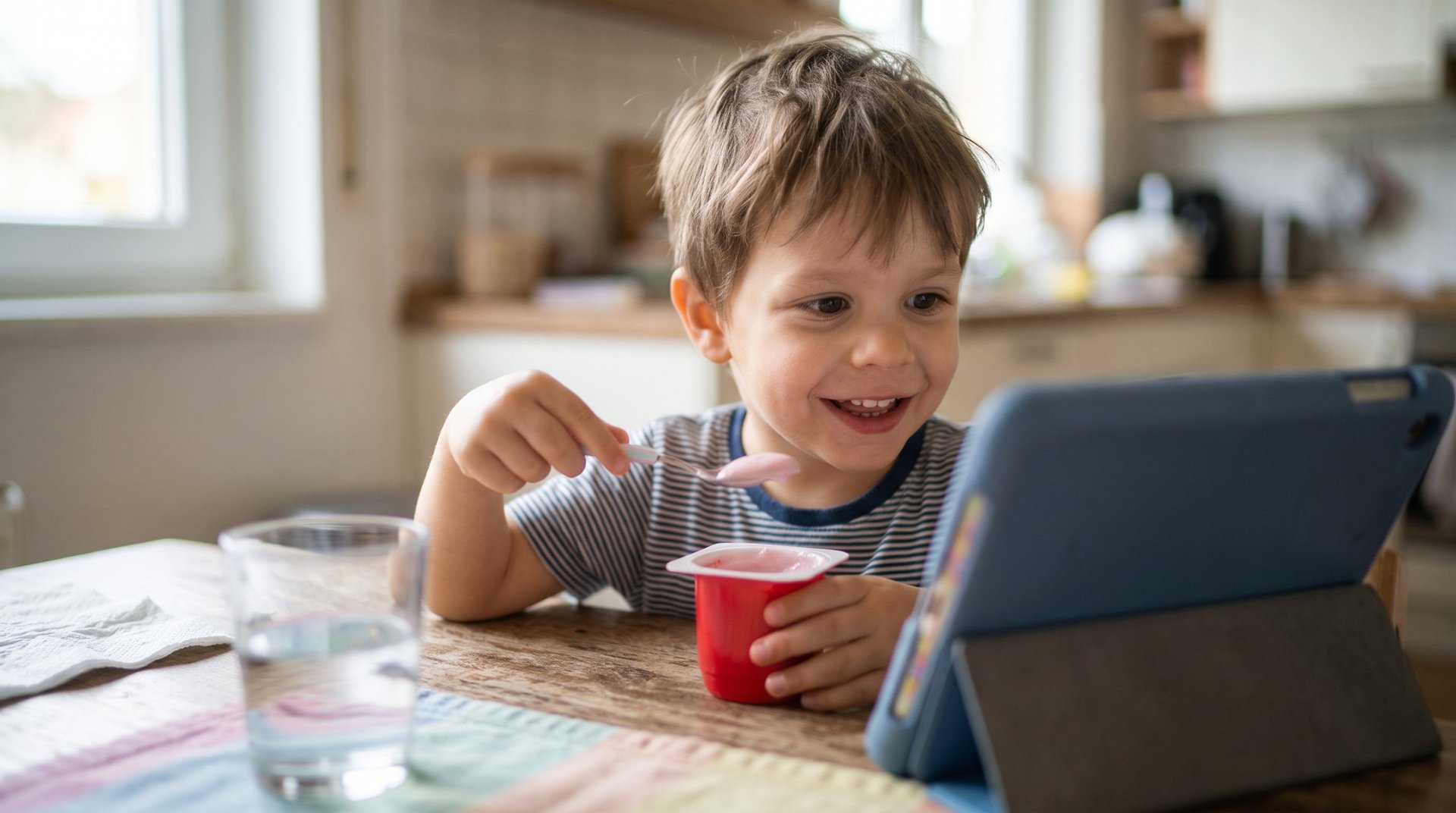
A global dairy company owns the favorite yogurt brand among children aged 3 to 9 in Mexico. With 30.1% stated preference according to Kidscorp's U18 Radar, it nearly triples the second brand in the category. For a children's food brand, the purchase decision has two protagonists: the child who asks for it and the adult who buys it. The company, its agency and Kidscorp worked together to reach the child at the time of year when, in addition, the adult is usually watching the same screen.
The challenge: the one who consumes and the one who decides
In Mexico, watching YouTube is the number one shared screen activity (parents and children) in the household. According to Kidscorp's U18 Radar, 73.7% of parents with children aged 3 to 9 say so, far above on-demand platforms (64.5%) and all broadcast and pay TV combined (46.0%).
That figure defines the problem and the solution at the same time. There was no need to build two campaigns, one for the child and another for the adult. What was needed was to be there when both were already together in front of the same screen.
The 2026 World Cup in Mexico took that behavior to its peak. But the match is not the only moment, nor the first: shared screen time is built before and sustained after.
“When a brand invests in U18 audiences, it cannot settle for impressions served. Our job is to raise the standard: complete delivery, safe environments and efficiency that improves month after month. The company confirmed that this standard is achievable and should be the norm, not the exception.”
The strategy: buying the moment, not just the age
The planning decision was to start from the real moment at home and not only from the age range. The buy was activated through the U18 DSP in a single combination, sustained throughout the campaign: YouTube In-Stream non-skippable, CPM buying, audience aged 3 to 9 in Mexico. This format does not compete for attention because the full message is delivered. In a family viewing environment, where the child watches and the adult is nearby, that complete delivery is worth more than a click.
Creative that works in two registers. The pieces had to hold the child's attention and, at the same time, say something to the adult in the room. Speaking not to an individual, but to a shared moment.
Four flights, not one peak. Investment was spread from April to July across four monthly flights, rather than a single concentration during the tournament.
In the children's food category, compliance with standards such as COPPA (Children's Online Privacy Protection Act) and local child protection regulations is not an additional administrative requirement: it is part of the strategy. Kidscorp's U18 DSP builds these safeguards into its brand safety and data governance architecture, which allowed the company to scale the campaign on YouTube with full regulatory confidence. That is a differentiator that generalist solutions do not offer in the food category.
The execution: build before, capitalize during
The 2026 World Cup kicked off on June 11. The first two flights ran before it: April, around Children's Day in Mexico, and May, when pre-World Cup conversation begins to settle in at home. June and July accompanied the tournament.
That sequence is the difference between accompanying a cultural moment and merely showing up in it. When the peak of family viewing arrived, the brand had already been present in the same environment for two months.
Results
Out of 9 million impressions delivered, 8.3 million were completed views. A 92.2% VTR means the message arrived in full more than 9 out of 10 times, against an 85% benchmark for the mass consumption vertical on YouTube Mexico.
What matters is not only the average, but the consistency. All four flights landed above the benchmark, with a floor of 88.8% in May and a ceiling of 94.3% in June. The campaign did not depend on one exceptional month.
At the same time, investment gained efficiency with each flight: the cost per thousand impressions dropped month after month in a sustained way, adding up to an 18% reduction between April and July. This means the brand not only reached its audience, but that reach cost less each time, confirming that the monthly flights strategy allowed constant learning and optimization.
Learnings
The cultural moment pays off if you arrive early. The flights before the tournament were not a warm-up. They placed the brand in the family environment before competition for attention peaked, and the June flight, with the World Cup already underway, had the best VTR of the entire campaign.
The value was in complete delivery, not in repetition. Frequency per flight stayed between 1.2 and 1.3 exposures per user. With little more than one impression per person, what made the difference was that the impression arrived in full.
Efficiency is built over the course of the flight, not negotiated at the start. April was the most expensive month, with Children's Day competition at its peak. From there the curve dropped steadily. Planning in monthly flights, instead of a single buy, is what gave the system room to learn.
Conclusion
If your brand also needs to connect with multiple decision-makers in the household or is looking for growing media efficiency, we invite you to approach your next communication challenge with the same mindset: identify the real moment when your audience is already gathered, before buying by age or demographics.